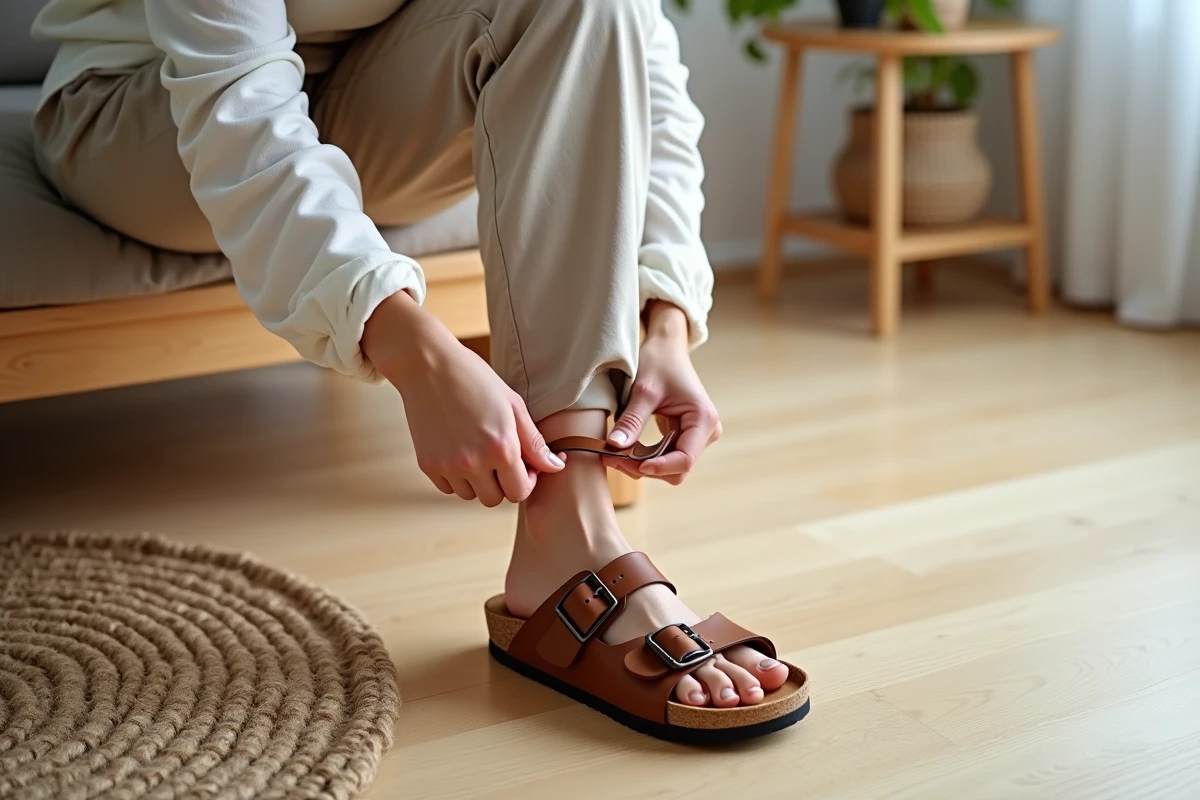
When you spend eight hours standing on tile or you’re covering miles on a coastal path, the choice between Scholl and Birkenstock is not trivial. Both brands promise comfort, but they achieve it in different ways. Gel sole versus cork footbed, immediate cushioning versus progressive support: the right sandal depends primarily on what you need from it on a daily basis.
Scholl gel sole versus Birkenstock cork footbed: two approaches to comfort
Scholl focuses on soles that incorporate gel or latex to absorb shocks from the very first step. You slip on the sandal, and the cushioning is there, with no break-in period. This explains the strong preference among healthcare professionals in hospital settings for this brand during long periods of standing: Scholl cushioning works from the first minute.
Birkenstock takes a different approach. Its cork and latex footbed gradually molds to the shape of the foot. The first few days may feel somewhat rigid, but after one to two weeks of regular wear, the sole conforms to natural pressure points. This personalized molding has been recognized by the American Podiatric Medical Association as particularly suitable for diabetic feet, thanks to an even distribution of pressure.
For a more detailed review of Scholl or Birkenstock, comparing materials and uses is worth exploring based on your situation.
In summary, if you need immediate comfort without a break-in period, Scholl has the advantage. If you’re looking for foot support that refines over time, Birkenstock rewards patience.

Durability of Scholl and Birkenstock sandals in real conditions
You don’t test a sandal on a waxed floor. You test it on wet sand, uneven cobblestones, a splashed kitchen floor. And that’s where the differences emerge.
Since 2024, consumer feedback has reported accelerated wear of Scholl soles in humid conditions. The UFC-Que Choisir association documented this trend in a March 2025 report, highlighting premature softening of the gel with repeated contact with water. For beach or humid environment use, this point deserves attention.
Birkenstock cork and new European standards
Birkenstock cork ages differently. It hardens slightly over the years but retains its supportive properties much longer than gel. The sole can be replaced by a cobbler, which extends the overall lifespan of the sandal.
On the regulatory side, the European REACH directive was strengthened in January 2026 (directive 2025/2784), requiring a reformulation of materials to reduce volatile organic compounds in cork footbeds. Birkenstock is directly affected. Scholl, whose soles rely on other materials, is not yet impacted by this development. Feedback varies on the actual impact on the comfort of the new Birkenstock models.
Choosing between Scholl and Birkenstock based on your daily use
The right reflex is to start from what you do with your sandals, not from what you read on a product sheet. Here are the criteria that make the difference:
- Prolonged standing (work in catering, healthcare, retail): Scholl offers gel cushioning that relieves without a break-in period, a clear advantage for long days on hard surfaces.
- Regular walking on varied terrain (city, trails, vacations): the Birkenstock cork sole absorbs ground irregularities and stabilizes the foot thanks to its pronounced arch.
- Sensitive feet or podiatric conditions: the gradual molding of Birkenstock is better suited for diabetic feet, while Scholl gel soles are recommended for neuropathies requiring superior cushioning.
- Frequent exposure to moisture (pool, beach, shower): the treated cork’s resistance remains superior to that of Scholl gel, which degrades faster upon contact with water.
Price and quality-durability ratio
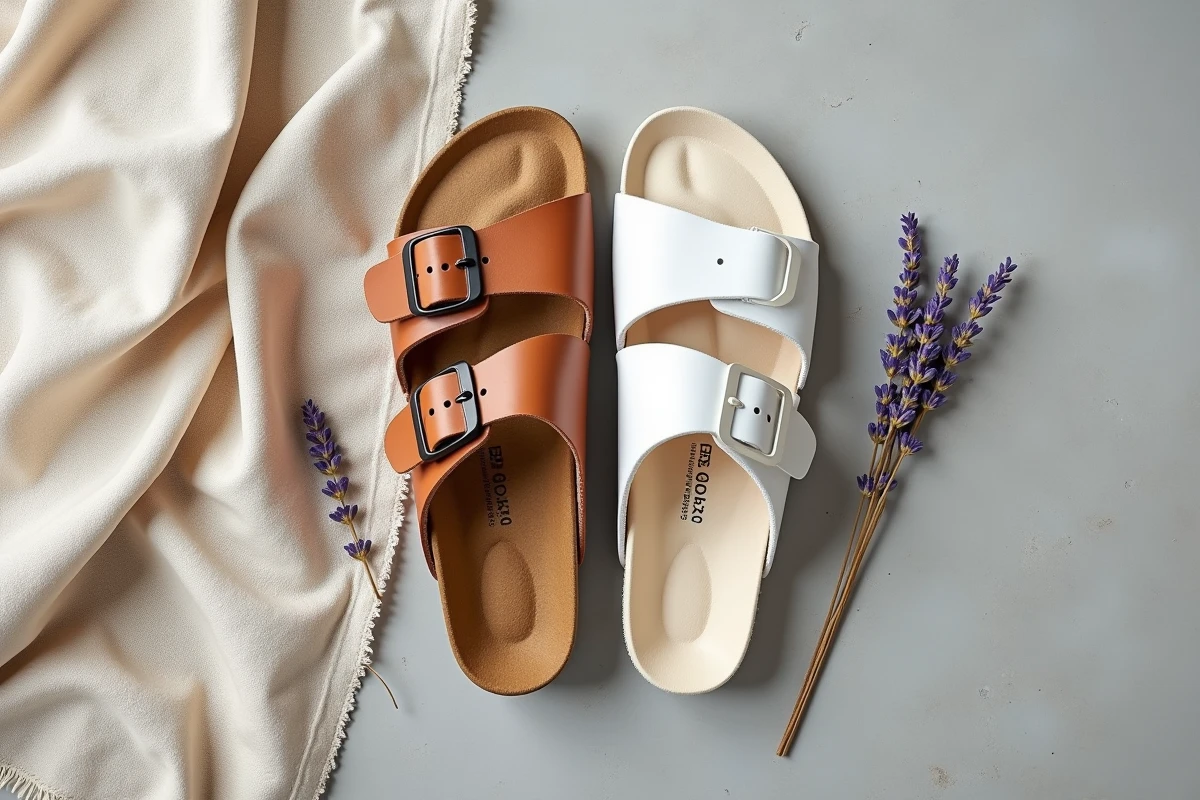
Birkenstock generally positions itself above Scholl in purchase price. You pay for leather, natural cork, and a manufacturing process that remains largely European. Scholl offers more accessible models, but their lifespan in intensive use is often shorter.
When calculated per year of use, Birkenstock often ends up being cheaper. An Arizona worn for three to four seasons with an intermediate resoling costs less than an annual replacement of gel sandals.
Style and versatility: Scholl or Birkenstock sandals for everyday wear
Scholl has long cultivated a medical image before offering more fashionable lines. Its recent models feature thin straps, varied colors, and materials like synthetic leather. They can be easily worn with city attire without signaling “orthopedic sandal.”
Birkenstock plays on a different register. The Arizona model, with its two wide straps and grained leather, has become a classic taken up by fashion collaborations. The Gizeh, with its toe post, is closer to a dressy flip-flop. Birkenstock’s natural leather develops a patina over time, which appeals to those who prefer a product that ages rather than one that wears out.
In terms of available models, Scholl offers a broader catalog including mules, clogs, and closed shoes, while Birkenstock remains focused on its historical silhouettes (Arizona, Boston, Gizeh, Madrid). For someone wanting a single brand covering multiple types of shoes, Scholl offers more versatility.
The choice between these two brands comes down to a question of priority: immediate cushioning and accessible price with Scholl, durable anatomical support and natural materials with Birkenstock. Starting from your actual use, rather than a brand preference, remains the most reliable method to avoid regretting your purchase at the end of summer.