
Replacing a hybrid battery doesn’t start with a quote. It starts with a differential diagnosis: is the fault coming from the traction battery, the 12 V auxiliary battery, or a single module within the pack? Confusing these three cases can lead to unnecessary bills or a full replacement when a targeted repair would be enough.
Hybrid battery diagnosis: traction battery, 12 V battery, or faulty module
A hybrid vehicle has two separate batteries. The 12 V auxiliary battery powers the main control unit and allows the vehicle to enter “READY” mode. When it starts to fail, the dashboard displays multiple warnings, the vehicle won’t start, and the symptoms can look like a traction battery pack failure. Replacing it costs a few hundred euros, not several thousand.
Before requesting a quote for a traction battery, we recommend measuring the 12 V battery’s voltage both under load and at rest. A multimeter is all you need. If the voltage drops below 11.5 V with the engine off, the 12 V battery is the problem.
When it comes to the traction battery pack, it’s rare for all the cells to fail at once. In NiMH batteries (Toyota Prius, Yaris Hybrid, Auris), one or two modules lose capacity while the others remain functional. A dedicated OBD diagnostic tool can identify the faulty module by measuring its internal resistance and discharge voltage.
Replacing just that module costs considerably less than replacing the entire pack. In lithium-ion batteries, module-level repairs are less common because of the cell architecture and the BMS (Battery Management System), which does not tolerate capacity differences between cells well.
The cost of replacing a hybrid battery depends directly on the results of this initial diagnosis. Replacing the entire pack without first ruling out the 12 V battery or identifying a single faulty module is like replacing an engine because of a faulty spark plug.
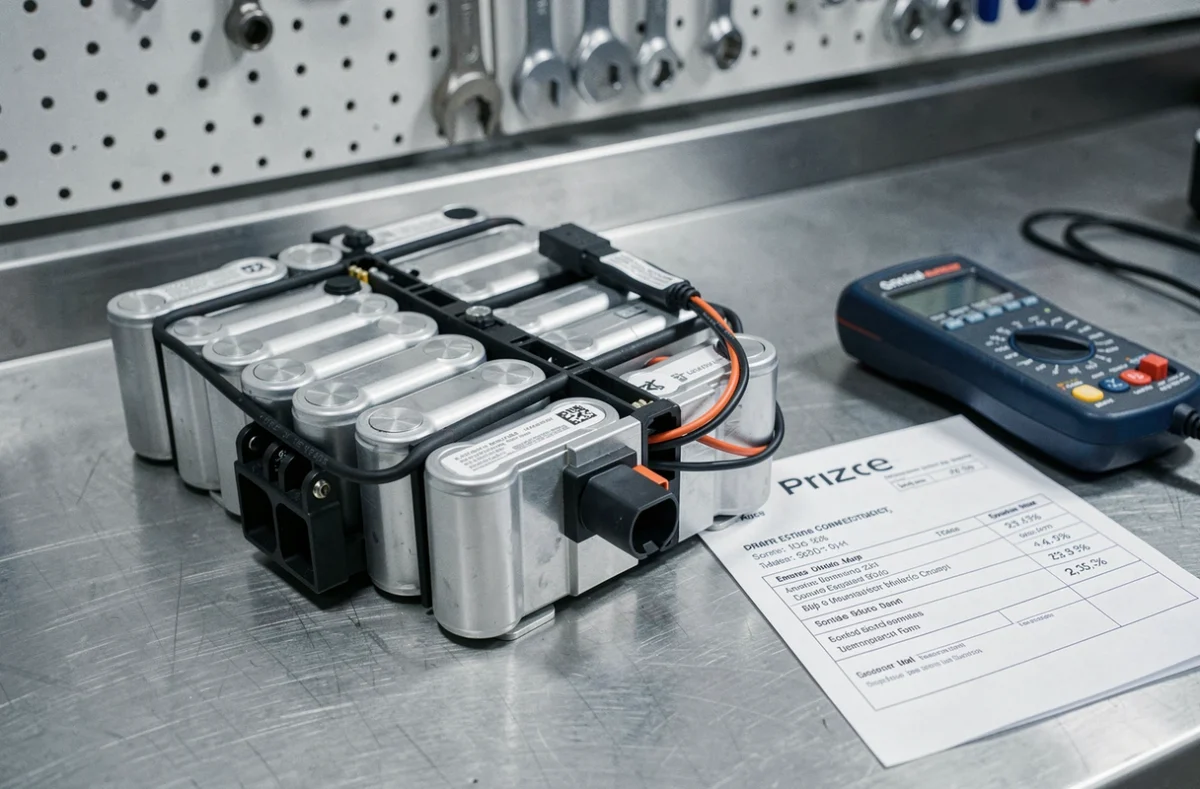
Hybrid battery prices: NiMH, lithium-ion, and plug-in hybrid
Battery technology has a greater impact on the price range than the vehicle’s make. There are three main scenarios.
| Battery type | Indicative price range (new battery) |
|---|---|
| NiMH (conventional hybrid) | €1,500 to €3,500 |
| Lithium-ion (conventional hybrid) | €2,500 to €4,000 |
| Plug-in hybrid (PHEV) | €3,000 to €8,000 |
These ranges are based on indicative prices published by a French specialist. The actual quote varies depending on the model, parts availability, and local labor costs. A plug-in hybrid battery is larger and takes longer to replace, which explains the difference.
Reconditioning reduces the bill, but two things need to be checked: the written warranty period and the capacity test results for the reconditioned pack. A reconditioned pack without a documented warranty is a gamble, not a saving.
Replacing individual modules in a NiMH battery
In a NiMH pack with 28 or 34 modules, replacing one or two faulty units costs a fraction of the price of a new pack. The risk is that the remaining original modules, already aged, may start to fail in the months that follow. Partial replacement makes sense if most of the modules still have a reasonable remaining capacity (above 80% of their rated capacity).
With lithium-ion batteries, module-level repairs are technically possible but uncommon commercially. The BMS must be reprogrammed to accept a new cell among degraded cells, which limits the number of workshops able to carry out the work.
Hybrid battery manufacturer warranty: what it really covers
Before paying, check what coverage is already in place. Toyota France offers a specific program: a traction battery health check may qualify the vehicle for renewable annual coverage, subject to age, mileage, and eligibility requirements. The stated limit is 10 years or 250,000 km for hybrid and plug-in hybrid vehicles.
Eligibility requirements vary by model and service history. A vehicle serviced through the manufacturer’s network is more likely to qualify for this extension than one serviced outside the network without documented records.
- Ask for the battery health check results before accepting any replacement quote
- Check whether the manufacturer’s warranty or an extended warranty still covers the traction battery pack
- Request a written quote detailing the part, labor, post-repair warranty, and test results

Replace the hybrid battery or sell the car: the break-even point
Replacement becomes uneconomical when it costs more than one-third of the vehicle’s market value. This isn’t an official threshold, but it’s a useful rule of thumb in the industry. A conventional hybrid that’s more than 12 years old with high mileage may be worth only €4,000 to €6,000 when resold. A new lithium-ion pack costing €3,500 would then represent half the vehicle’s value.
The analysis shouldn’t be limited to the battery price. You also need to consider the condition of the rest of the vehicle, including the transmission, suspension, and bodywork. A new pack in a vehicle that needs another €2,000 in suspension work is not a rational investment.
Reconditioned battery: balancing price and durability
Reconditioning can keep an older vehicle below the break-even threshold. An acceptable compromise is a reconditioned battery with at least a 12-month warranty and documented capacity test results. Without this warranty, the risk of needing another repair within a year wipes out the initial savings.
Always compare three scenarios in writing: a new replacement, a reconditioned battery, and the vehicle’s resale value as-is. For some widely available models (Prius II and III, Yaris HSD), the reconditioned market is well established and prices are competitive. For rarer hybrids, reconditioned packs are less readily available, pushing prices up.
A hybrid battery replacement should be decided on the basis of a diagnosis, not before one. A faulty module, a weak 12 V battery, or an active manufacturer’s warranty can turn a quote of several thousand euros into a repair costing just a few hundred. When a full replacement is necessary, the deciding factor is the comparison between the total repair cost and the vehicle’s residual value.