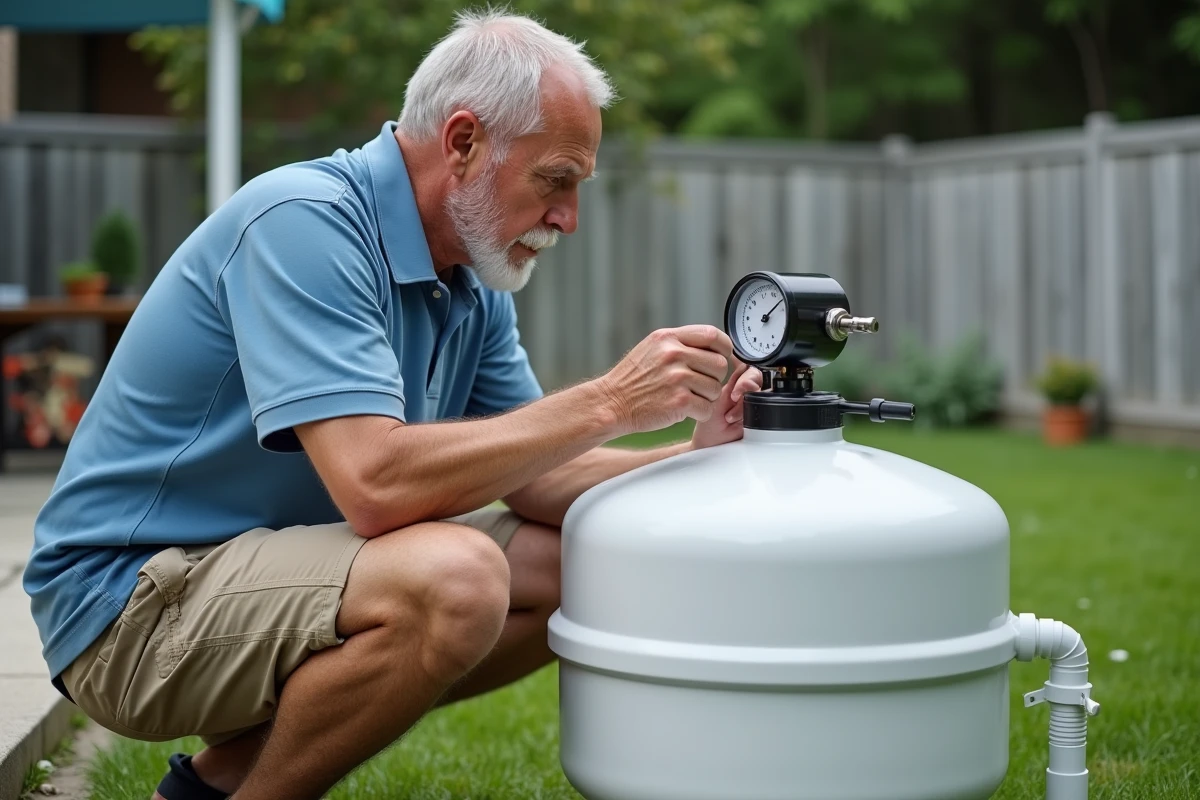
A pressure gauge that rises after a few days of swimming, water that loses its clarity for no apparent reason, a return flow that weakens: we often face the sand filter without knowing if the displayed pressure is normal or if it indicates a problem. Understanding what the pressure gauge indicates helps avoid unnecessary backwashing or, worse, running a clogged filtration system for weeks.
Reading the sand filter pressure gauge correctly
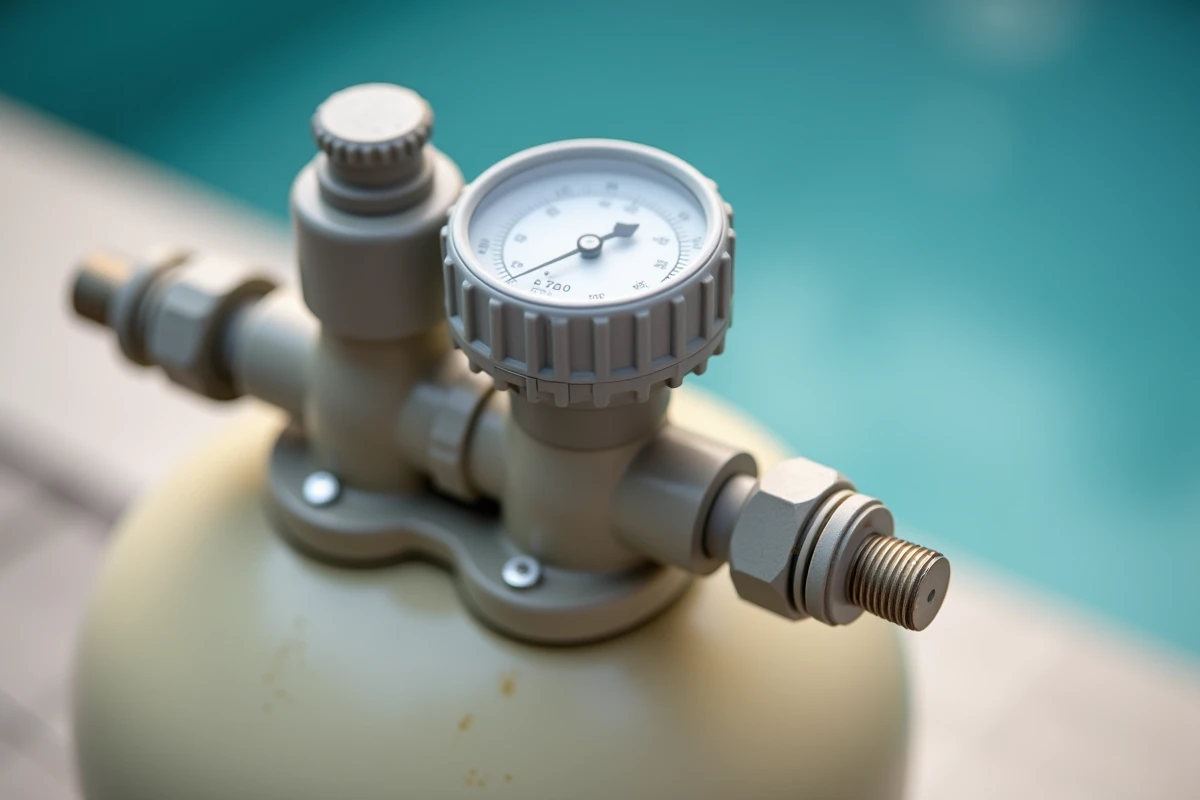
The pressure gauge is screwed onto the lid or body of the filter. It displays a value in bar or psi, depending on the model. The first thing to do after starting up or backwashing is to note the reference pressure when the sand is clean and the pump is running at normal speed.
This starting pressure varies from one installation to another. It depends on the diameter of the filter, the power of the pump, the length of the pipes, and the type of sand used. Comparing the value with a neighbor’s is pointless: only the reference pressure of your own installation matters.
A clogging is identified when the pressure significantly exceeds this reference. A significant deviation above the initial value indicates that the sand is retaining enough dirt to hinder the flow of water. This is the signal to initiate a wash. To properly understand the normal pressure of the pool sand filter, one must think in terms of deviation from this clean reference, not in absolute value.
Backwashing the sand filter: when and how to initiate it
Backwashing reverses the direction of water flow in the filter. The sand is lifted, and trapped impurities are discharged into the drain. This is the most common maintenance operation on a sand filter and the only one that immediately reduces the pressure on the gauge.
Step-by-step washing procedure
- Stop the filtration pump before manipulating the multiport valve, to avoid damaging the internal mechanism or the star seal.
- Turn the valve to the “wash” (or “backwash”) position, then restart the pump. Let it run until the water visible in the turbidity indicator (the sight glass) becomes clear.
- Turn off the pump again, switch the valve to the “rinse” position, and restart for about thirty seconds. This step recompacts the sand and prevents sending cloudy water back to the pool.
- Stop the pump, set the valve back to “filtration,” and restart. Note the new reference pressure on the gauge.
Never turn the multiport valve while the pump is running. This is the most common cause of breakage in domestic sand filtration systems.
Low filter pressure: causes and field diagnosis
An abnormally low pressure, below the usual reference, does not mean everything is fine. It often indicates a problem with the water supply on the suction side.
The first reflex is to check the pre-filter basket of the pump. A basket clogged with leaves, hair, or insects reduces the flow before the water even reaches the filter. A clogged pre-filter simulates low pressure on the gauge, while the real problem lies upstream.
Other avenues to explore when the pressure remains low:
- Water level in the pool too low, causing air to enter the skimmer and cavitate the pump.
- Air leak on a suction fitting, a defective pump lid seal, or a loose clamp.
- Broken or detached strainers at the bottom of the filter, allowing sand to pass into the return circuit (resulting in sand at the bottom of the pool).
Returns vary on this point, but a noisy pump showing low pressure with air bubbles in the return almost always points to an air intake on the suction line.
Sand maintenance and replacement: concrete signs
Filtration sand does not last forever. Over time, the grains erode, compact, and lose their filtering power. One then observes water that remains slightly cloudy despite regular backwashing, or pressure that rises very quickly after each wash.
Sand that clogs within a few days after washing likely needs to be replaced. The lifespan depends on the volume of swimming, the quality of the raw water, and the consistency of chemical maintenance. Inadequate treatment (excess lime, poorly regulated pH) accelerates the formation of blocks in the filtering mass.
Check the condition of the sand without emptying the filter
You can open the filter lid (pump stopped, pressure relieved) and observe the surface of the sand bed. Good quality sand has loose grains, without crusts or hard clumps. If the surface forms a compact plate or emits an odor, it is a sign of advanced degradation.
Before replacing all the sand, a chemical cleaning with a specific descaling product for sand filters can sometimes restore filtering capacity. The product is poured into the filter, left to act for several hours with the pump stopped, then a prolonged backwash is performed. This treatment only works if the sand is not physically worn, meaning the grains still have their original angular shape.

Defective pressure gauge: a common false problem
The pressure gauge itself may be at fault. Exposed to pump vibrations, chemicals, and temperature variations, it is a wear part that is often overlooked. A needle that remains stuck, oscillates erratically, or shows zero while the pump is running indicates a malfunctioning gauge.
Replacement is simple: turn off the pump, unscrew the old one, wrap Teflon tape around the threads of the new one, and screw it back in. A reliable pressure gauge is the basic condition for any pressure diagnosis. Without it, one operates blindly.
Keeping a small notebook or a note on your phone with the reference pressure recorded after each wash allows you to spot a gradual drift well before the water becomes cloudy. This is the simplest and most underestimated maintenance gesture on a pool sand filtration system.